Hackers on the Air

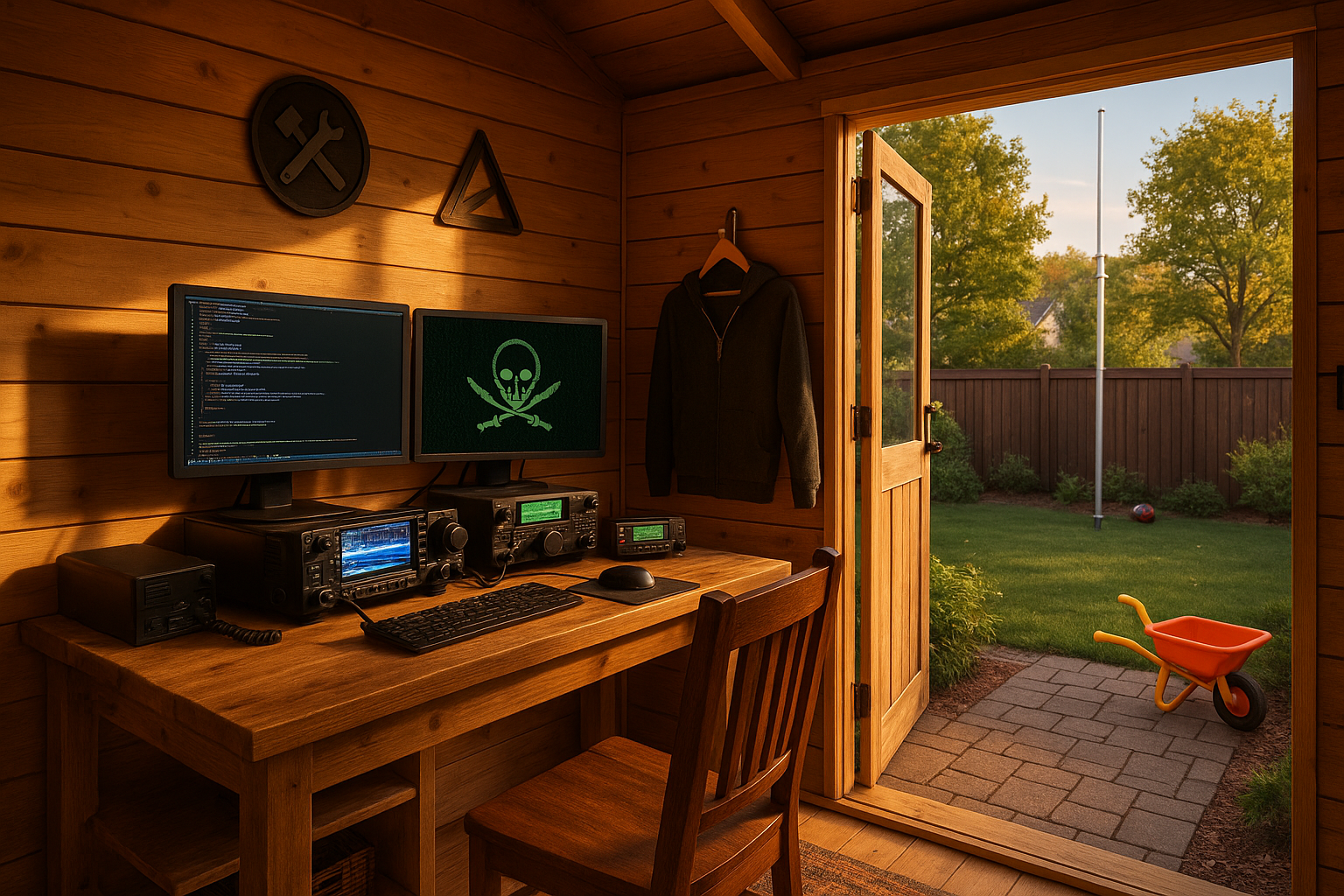
I’ve been a licensed amateur radio operator (a Ham) since 2005. Despite that, I’ve held only the entry-level license for nearly two decades. But in 2025, I finally changed that. Along the way, I rediscovered just how vast and fascinating the world of Ham Radio truly is.
In the U.S., amateur radio licenses are issued by the FCC and are required to legally transmit on any of the allocated amateur bands. Transmitting without a license isn’t just discouraged, it’s against the law. There are three classes of licenses, each offering increasing privileges:
- Technician Class: The entry-level license. Grants access primarily to the VHF (Very High Frequency) and UHF (Ultra High Frequency) bands. These are ideal for local communication, especially via handheld radios and repeaters. A small portion of the HF (High Frequency) bands is also available.
- General Class: The next level up, unlocking a much wider range of HF frequencies. With this license, you can communicate across the country and even worldwide.
- Extra Class: The highest level, granting full privileges across all amateur bands, including exclusive segments of the HF range and access to premium call sign formats like the “1x2” format (e.g., N1XX).
Understanding UHF, VHF, and HF
Ham radio spans a wide range of frequencies, each with unique characteristics:
- UHF (Ultra High Frequency): 300 MHz to 3 GHz
Commonly used for handheld radios, repeaters, and short-range communication. UHF works well in urban environments and indoors, but signals can be blocked more easily by buildings, hills, and trees. - VHF (Very High Frequency): 30 MHz to 300 MHz
Great for regional communication. Often used in public safety and amateur repeater networks. VHF performs better than UHF in open areas and hilly terrain but doesn't always penetrate buildings as well. - HF (High Frequency): 3 MHz to 30 MHz
This is where the magic of long-distance (DX) communication happens. HF signals bounce off the ionosphere, enabling contact with stations thousands of miles away. These setups often require more space and larger antennas, but they make global communication possible. - Digital Voice Modes (DMR, D-STAR, System Fusion, etc.)
These protocols run over VHF and UHF and support crystal-clear digital voice, error correction, callsign routing, and internet-linked repeaters. A handheld radio and hotspot can get you worldwide access, no tower required.
Getting Back on the Air
After 20 years, a fellow hacker and friend sparked my interest again. He was researching amateur radios and their Bluetooth capabilities, and I mentioned I still had an active license. I had kept it valid all these years, even if I wasn’t using it.
That conversation lit a fire. I dug my old radios out of storage and began setting everything up again.
First, I installed a mobile radio in my car along with an external antenna. This setup lets me transmit and receive while on the road. It’s perfect for checking in with my local repeater network, which is like a persistent conference call for the community.
I also pulled out a few of my handheld radios (commonly called HTs) and started carrying one in my backpack every day. Outdoors, they work great for accessing local repeaters. Indoors, performance varies depending on signal strength, even with a better antenna. Small radios and building walls don’t always play nicely.
Building the Shack
As usual, I’ve gone a bit overboard in my home office, which also doubles as my backyard radio shack. I now have three radios set up, and likely more on the way. Each one serves a unique role across the frequency spectrum.
- HF: I use the ever-popular ICOM 7300, a modern classic for long-range communication. It’s connected to a 40-meter off-center fed dipole (OCFD) antenna, which delivers great performance on 40 meters and several other HF bands. The antenna is strung between two points in the yard and elevated to get a decent takeoff angle for DX contacts.
- VHF/UHF and Simplex: I’m running a very dependable Yaesu FT-8100. It may be old, but it still performs reliably. This rig is paired with a Diamond X-30 vertical antenna, mounted high and clear to maximize line-of-sight communication. It’s compact but efficient, perfect for repeaters and local simplex work.
- DMR (Digital): I use a Radioddity DB25-D, which connects to a Wi-Fi hotspot for access to the BrandMeister network. This allows me to join digital talkgroups and connect with hams across the globe.
With this trio of radios and properly matched antennas, I’ve got solid coverage across nearly every band I care about. From local repeater nets and casual simplex chats to international DX contacts, I’m doing it all from a cozy 200-square-foot shack in my backyard.
Not bad for a “Technician” who took a 20-year break.